

Dwell time – what does this valuable SEO metric tell us?
Dwell time is one of the key metrics in website positioning and performance measurement. It is significant both from the perspective of users and search engines. In this article, we will examine dwell time and discuss how to maximize it.
What is dwell time?
Dwell time measures the amount of time users spend on our website. The higher the dwell time, the more time the user naturally spends on the page. This is very valuable information for us as SEO specialists and website administrators. Dwell time is also considered by many search engine algorithms during the process of ranking websites in search results.
Dwell time is not the same as average time spent on site. Average time is the sum of all visits divided by their number. These metrics should not be confused, as they have different applications in SEO and measure different things.
Dwell time is influenced by metrics such as Click-through rate (CTR) and Bounce rate.
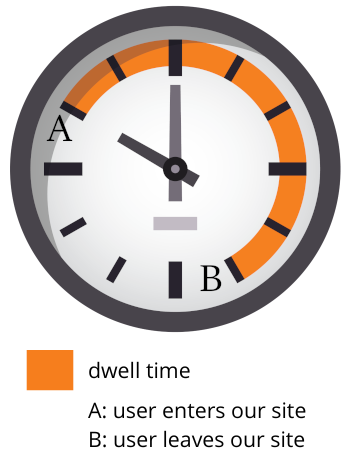
What algorithms take dwell time into account?
Google's algorithms are complex and the California-based giant often doesn't provide official information or details about how they work. However, based on the experience and assumptions of SEO specialists, it has been concluded that the following updates and indices pay attention to dwell time: Page Experience Update, Core Web Vitals, and Mobile-First Index.
Dwell time and positioning
A great website can make people stay longer. You can do this by:
If we focus on these things, people will stay on our site longer. This tells search engines that our site is really good and should be ranked higher in search results (SERP).
How to measure dwell time?
Dwell time is a metric that we can, and should, measure and monitor. It provides valuable insights into the usefulness and accessibility of the site. Dwell time can be measured using:
In Google Analytics, dwell time is represented by the metric "Average time on page". We can check it by going to the Behavior > Site Content > All Pages section.
My dwell time is low - what should I do?
A low dwell time indicates that certain elements of the page need to be improved. We will likely need to work on optimizing content, headings, clarity, and site navigation. We should ensure readability, perhaps change colors, improve loading speed, and add more internal links so that the user can easily click from one section to another. After each change, we should carefully monitor dwell time. Remember, this is a very important indicator for SEO, so it's worth focusing on its optimization.
➡️ Read also: What are the dangers of thin, low quality content?
Check out our professional services and see how we can help your business.

Jan Wojciechowski
Content Marketing Specialist
Content Marketing Specialist with several years of experience. Studied Marketing and Management on the University of Warsaw. In his work he tries to combine his writing skills, content knowledge and passion for new technologies. Privately he likes to do sports, read books and illustrate them.